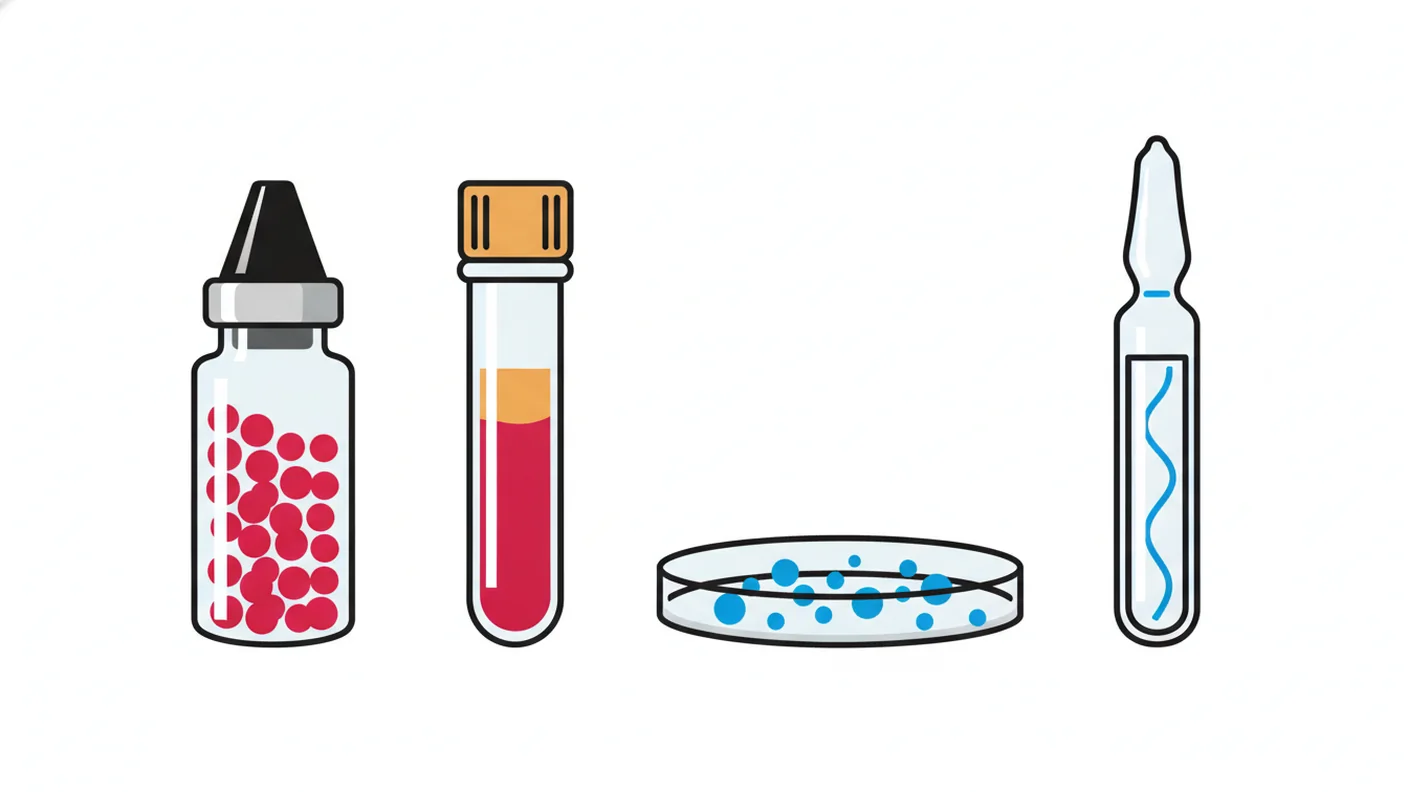
What regenerative medicine actually covers
In aesthetic practice, “regenerative” describes four distinct families of product: living autologous cells; platelet-rich plasma, which contains platelets rather than stem cells; cell-free products such as conditioned media and exosomes; and polynucleotides including PDRN, which contain no cellular material at all. They share a marketing category and almost nothing else. Their mechanisms differ, their regulatory routes differ, and the amount of clinical evidence behind them differs by orders of magnitude. Reading a clinic page without that distinction in mind is how people end up paying for the least-evidenced option in the set.
Why the category is misleading
Regenerative medicine, as a research field, means using cells or cell-derived material to restore tissue structure or function. That is a legitimate and productive area of science. The difficulty is that the word travelled into aesthetic marketing intact, where it now attaches to any product a clinic wishes to describe as renewing rather than merely filling. The result is a category whose members have less in common than the label implies.
Living nucleated cells
- Autologous MSCs
- Stromal vascular fraction
- Adipose-derived cells
Anucleate fragments in plasma
- Platelet-rich plasma (PRP)
Cell-derived, cell-free
- Conditioned media
- Exosomes and other extracellular vesicles
No cellular material
- PDRN
- Polynucleotides (PN)
The useful question is not “is this regenerative?” but “what is in it, and what has been shown about that specific thing?” The table below is the compressed answer; the sections after it explain each row.
Four families of regenerative aesthetic product: contents, strongest published study design, and principal limitation.
Autologous cells (MSC, SVF, ADSC)
- What is actually administered
- Living nucleated cells harvested from the patient, processed to some degree, and returned.
- Strongest published evidence
- Systematic review of cell-assisted lipotransfer, where cells are added to a fat graft rather than injected as a treatment in themselves.
- Principal limitation
- Graft-retention rates in the underlying literature range from roughly 25% to 80%. Processing methods are not standardised between clinics.
Platelet-rich plasma (PRP)
- What is actually administered
- The patient’s own blood, centrifuged so platelets concentrate in a small plasma volume. Contains no stem cells.
- Strongest published evidence
- Multiple systematic reviews and meta-analyses of randomised controlled trials, chiefly in androgenetic alopecia.
- Principal limitation
- The largest meta-analysis graded the certainty of benefit as low, citing inconsistency and risk of bias. Preparation protocols vary between studies.
Exosomes / extracellular vesicles
- What is actually administered
- Nanoscale vesicles released by cells, carrying proteins, lipids and nucleic acids. A cell product without the cell.
- Strongest published evidence
- Narrative and comprehensive literature reviews of early clinical work and case reports.
- Principal limitation
- No exosome product holds US FDA approval for any indication. Isolation and characterisation methods differ between suppliers, so "exosome" on two labels need not mean the same material.
PDRN / polynucleotides (PN)
- What is actually administered
- Purified DNA fragments, in the case of PDRN derived from salmon sperm DNA. No cells and no cell fragments.
- Strongest published evidence
- A systematic review of nine studies in aesthetic use, plus a substantial pharmacology literature on PDRN in wound healing.
- Principal limitation
- The included aesthetic studies were of low to moderate quality, with 219 patients in total and no consensus on optimal use.
| Modality | What is actually administered | Strongest published evidence | Principal limitation |
|---|---|---|---|
| Autologous cells (MSC, SVF, ADSC) | Living nucleated cells harvested from the patient, processed to some degree, and returned. | Systematic review of cell-assisted lipotransfer, where cells are added to a fat graft rather than injected as a treatment in themselves. | Graft-retention rates in the underlying literature range from roughly 25% to 80%. Processing methods are not standardised between clinics. |
| Platelet-rich plasma (PRP) | The patient’s own blood, centrifuged so platelets concentrate in a small plasma volume. Contains no stem cells. | Multiple systematic reviews and meta-analyses of randomised controlled trials, chiefly in androgenetic alopecia. | The largest meta-analysis graded the certainty of benefit as low, citing inconsistency and risk of bias. Preparation protocols vary between studies. |
| Exosomes / extracellular vesicles | Nanoscale vesicles released by cells, carrying proteins, lipids and nucleic acids. A cell product without the cell. | Narrative and comprehensive literature reviews of early clinical work and case reports. | No exosome product holds US FDA approval for any indication. Isolation and characterisation methods differ between suppliers, so "exosome" on two labels need not mean the same material. |
| PDRN / polynucleotides (PN) | Purified DNA fragments, in the case of PDRN derived from salmon sperm DNA. No cells and no cell fragments. | A systematic review of nine studies in aesthetic use, plus a substantial pharmacology literature on PDRN in wound healing. | The included aesthetic studies were of low to moderate quality, with 219 patients in total and no consensus on optimal use. |
Family one: living autologous cells
This is what “stem cell treatment” literally means — mesenchymal stromal cells, stromal vascular fraction, or adipose-derived cells taken from the patient, processed, and administered back. Mesenchymal stromal cells attract research attention because they have immunomodulatory and regenerative functions demonstrated across a large body of laboratory and animal work[2].
In aesthetic and reconstructive surgery, the best-developed clinical application is not cells as a treatment in themselves but cells added to a fat graft to improve how much of the graft survives. A systematic review of this approach — cell-assisted lipotransfer, using PRP, stromal vascular fraction or adipose-derived stem cells as the enrichment — describes it as promising while noting that graft retention across the literature ranges from about a quarter to about four-fifths, and that transferring these techniques into standardised, good manufacturing practice-compliant production remains an open problem[9]. That gap between laboratory promise and reproducible clinical result is the honest state of the field.
It is also the family where regulation bites hardest. A living cell administered to a person behaves differently from a molecule, and jurisdictions treat it accordingly. Korea’s framework for advanced regenerative medicine routes these interventions through institutional designation and committee review before they may be conducted at all.
Family two: platelet-rich plasma
Plasma
The large upper volume after spinning.
Platelet-rich layer
A thin band. This is what is drawn off and injected.
Red cells
The dense lower fraction, discarded.
The point: Platelets are anucleate cell fragments. PRP contains no stem cells, and preparation protocols vary between studies and between clinics.
PRP is the patient’s own blood, drawn and centrifuged so that platelets concentrate into a small volume of plasma, which is then injected. Platelets are anucleate cell fragments that release growth factors on activation. They are not stem cells, and PRP is not a cell therapy in the regulatory sense — which is one reason it is more widely available than the first family.
PRP is also the modality where the research community actually ran the trials. There are randomised controlled trials in androgenetic alopecia and meta-analyses pooling them[6]. Reviews of the treatment landscape for pattern hair loss now list PRP alongside minoxidil, finasteride and low-level light therapy, while noting that only the latter three hold FDA approval for the indication[10]. What the trials show, and what they fall short of showing, is set out on the PRP and polynucleotides page.
Family three: exosomes and conditioned media
Cells in culture release material into their surrounding medium. Collect that medium and you have conditioned media; isolate the small vesicles from it and you have an exosome preparation. Both are cell-derived and cell-free, which is the source of both their appeal and their regulatory ambiguity: no living cell is administered, yet the material is biologically active.
The mechanistic literature is genuinely interesting. Exosomes carry proteins, lipids and nucleic acids between cells, and stem cell-derived exosomes have been shown in laboratory and animal models to reduce matrix metalloproteinase expression and increase collagen and elastin production[3]. Reviews of dermatological applications describe plausible roles across wound healing, ageing and pigmentation[4].
Two facts should accompany all of that. First, no exosome product holds US FDA approval for any indication, and reviews of cosmetic use identify inconsistent isolation methods, source variability and the absence of long-term safety and efficacy trials as unresolved[5]. Second, the field has struggled to agree on what an exosome even is for measurement purposes: the International Society for Extracellular Vesicles has issued three successive editions of minimum reporting standards, most recently MISEV2023, specifically to address nomenclature, separation from non-vesicular particles, and characterisation[1]. If laboratories need a standard to agree on the terms, two clinic price lists using the same word are not necessarily describing the same material.
Family four: polynucleotides and PDRN
PDRN is a mixture of deoxyribonucleotides of defined molecular weight range, produced from salmon DNA through a controlled purification and sterilisation process designed to remove protein and peptide content. Its proposed mechanism is engagement of the adenosine A2A receptor together with supply of nucleosides for the salvage pathway[7]. It contains no cells and no cell fragments, which makes calling it “regenerative” a statement about proposed mechanism rather than about content.
A 2024 systematic review of polynucleotides in aesthetic medicine found nine studies covering 219 patients, rated them low to moderate quality, and reported promising results on wrinkle depth, texture and elasticity alongside limited consensus on optimal use[8]. That is a fair description: some signal, small studies, no settled protocol. It is also worth noting that PDRN pharmacology should not be assumed to transfer wholesale to every product marketed as a polynucleotide — the source material, molecular weight distribution and manufacturing differ, and the mechanistic literature was built on PDRN specifically.
What to take from this page
When a clinic, an advertisement or a search result says “regenerative,” the word has told you nothing yet. Ask which of the four families the product belongs to. Then ask what study design supports it for your specific indication — the evidence levels page explains how to tell a meta-analysis from a case series and why the difference matters more here than in most of medicine. If the answer to either question is unclear, that is itself information.
References
- Welsh JA, Goberdhan DCI, O'Driscoll L, et al. Minimal information for studies of extracellular vesicles (MISEV2023): From basic to advanced approaches. J Extracell Vesicles. 2024;13(2):e12404. doi:10.1002/jev2.12404 · PMID:38326288
- Ha DH, Kim HK, Lee J, et al. Mesenchymal Stem/Stromal Cell-Derived Exosomes for Immunomodulatory Therapeutics and Skin Regeneration. Cells. 2020;9(5):1157. doi:10.3390/cells9051157 · PMID:32392899
- Hajialiasgary Najafabadi A, Soheilifar MH, Masoudi-Khoram N. Exosomes in skin photoaging: biological functions and therapeutic opportunity. Cell Commun Signal. 2024;22(1):32. doi:10.1186/s12964-023-01451-3 · PMID:38217034
- Xiong M, Zhang Q, Hu W, et al. The novel mechanisms and applications of exosomes in dermatology and cutaneous medical aesthetics. Pharmacol Res. 2021;166:105490. doi:10.1016/j.phrs.2021.105490 · PMID:33582246
- Haykal D, Wyles S, Garibyan L, Cartier H, Gold M. Exosomes in Cosmetic Dermatology: A Review of Benefits and Challenges. J Drugs Dermatol. 2025;24(1):12-18. doi:10.36849/JDD.8872 · PMID:39761139
- Cruciani M, Masiello F, Pati I, Marano G, Pupella S, De Angelis V. Platelet-rich plasma for the treatment of alopecia: a systematic review and meta-analysis. Blood Transfus. 2023;21(1):24-36. doi:10.2450/2021.0216-21 · PMID:34967722
- Squadrito F, Bitto A, Irrera N, et al. Pharmacological Activity and Clinical Use of PDRN. Front Pharmacol. 2017;8:224. doi:10.3389/fphar.2017.00224 · PMID:28491036
- Lampridou S, Bassett S, Cavallini M, Christopoulos G. The Effectiveness of Polynucleotides in Esthetic Medicine: A Systematic Review. J Cosmet Dermatol. 2025;24(2):e16721. doi:10.1111/jocd.16721 · PMID:39645667
- Debuc B, Gendron N, Cras A, et al. Improving Autologous Fat Grafting in Regenerative Surgery through Stem Cell-Assisted Lipotransfer. Stem Cell Rev Rep. 2023;19(6):1726-1754. doi:10.1007/s12015-023-10568-4 · PMID:37261667
- Nestor MS, Ablon G, Gade A, Han H, Fischer DL. Treatment options for androgenetic alopecia: Efficacy, side effects, compliance, financial considerations, and ethics. J Cosmet Dermatol. 2021;20(12):3759-3781. doi:10.1111/jocd.14537 · PMID:34741573
Bibliographic records retrieved from PubMed (U.S. National Library of Medicine). Citation here indicates the source of a statement, not endorsement by its authors of any clinic or product.
Written by the Stem Cell Seoul editorial team and medically reviewed by a Korean Board-Certified Dermatologist (AAD International Fellow · ASLMS member). Last reviewed 2026-08-30.